The Latest SAA Newsletter
Registration Now Open for 10th Annual Materials Innovations Summit
The automotive industry is evolving, and across ICE, hybrid, and EV platforms, automakers and suppliers face the same challenge: improving efficiency, performance, and safety while controlling weight and cost.
Modern lightweighting demands balancing performance, manufacturability, cost, durability, and complex architectures — with no single material providing the answer, as steel, aluminum, composites, plastics, and enabling technologies each offer unique advantages that must work together to optimize the vehicle as a whole.
Join us for the 10th Annual Materials Innovation Summit on November 11, where industry experts explore the technologies and opportunities shaping the next generation of automotive lightweighting.
This event is free to SAA members and only $49 for non-members (includes a 1-year SAA membership).
Click here for more information and to register.
SAA Members Receive Discount to Service & Warranty Lifecycle Summit
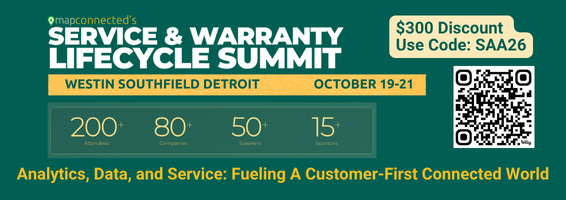
MAPconnected’s 6th Annual Service & Warranty Lifecycle Summit, taking place October 19–21, 2026, at The Westin Southfield Detroit, will bring together more than 200 leaders from 80 companies across warranty, quality, technical assistance, field service, aftersales, aftercare and technology.
The Summit brings together executives and decision-makers responsible for the issues shaping the future of the Service, Warranty & Aftercare lifecycle, with a focus on AI investments, operating priorities, data, quality, customer experience and performance challenges. The Summit will examine how organizations are addressing common challenges around AI in warranty and quality, connected and software-defined vehicles, diagnostic support, warranty governance, supplier accountability, dealer capability, technical assistance, recalls, data and customer experience.
A Tech Expo and more than 12 hours of networking, including Tuesday executive dine-around dinners, extend the conversations beyond the formal program.
SAA members receive $300 off Summit registration with code SAA26. Group discounts are also available for teams of three or more. Click here for full Summit Details.
Last YPN Networking Event of the Year to Focus on Autonomous Vehicles with Speaker from Kodiak
Join SAA’s Young Professionals Network on November 5 at Craft Breww City in Farmington Hills, MI, for the group’s final networking event of 2026. Fabian Lischke of Kodiak Robotics will provide his insights on “Autonomous Vehicles – Deploying, Scaling, and its Impact on Industry.”
The event is free to attend and is sponsored by Donnelly Penman and Partners.
Click here for more information and to register.
Foley Automotive Update
Stay informed with Foley’s latest Automotive Update, delivering timely insight into the market forces, policy developments, and emerging risks shaping today’s automotive industry. This edition covers mounting pressure from rising fuel costs, evolving trade and tariff policies, and increasing geopolitical uncertainty that continue to impact automakers, suppliers, and consumers alike. It also highlights key developments involving Chinese vehicle and technology restrictions, shifting production strategies, and the growing role of autonomous and connected vehicle technologies.
From supply chain and trade considerations to regulatory and competitive trends, this update provides practical takeaways to help automotive leaders evaluate risk, identify opportunities, and navigate a rapidly changing business environment.
Click here to access the latest Foley Automotive Update.

Wage Growth Outpaces Increase in New Vehicle Prices, Affordability Concerns Persist
A new analysis on vehicle affordability in the United States finds that household earnings have improved relative to new vehicle prices. However, new vehicle affordability remains a concern for consumers.
Click here for the rest of the article.
Plante Moran’s 2026 Year-End Webinar Series
Prepare for year-end with Plante Moran’s annual webinar series, featuring 6 CPE-eligible sessions covering audit and accounting, employee benefits, digital transformation, IT and cybersecurity diligence, and individual and business tax planning. Gain strategic insights to help you finish the year strong and start 2027 smarter.
Why OEM-Supplier Collaboration Is Becoming a Competitive Advantage
Inspired by insights from a recent SAA webinar, this perspective examines why early OEM-supplier collaboration is becoming a competitive advantage in the software-defined vehicle era.
As vehicles become more software-defined, the most successful OEM-supplier relationships will be those that shift from transactional handoffs to trusted, early-stage co-development that helps accelerate innovation, reduce risk and create greater value. The conversation, moderated by Kalea Hall, Automotive Reporter for Reuters, featured Peter Schmitt, Software Product Line Executive Director at Nexteer, and Bernard Swiecki, Vice President of Mobility & Research at Detroit Regional Partnership. Together, they explored how OEM-supplier relationships are evolving from transactional sourcing models to collaborative innovation partnerships.
Click here for the rest of the article.
Why Early Restructuring Gives Automotive Suppliers More Options
Automotive suppliers have been absorbing disruption for years. Tariffs followed chip shortages, the pandemic, slowing sales, the UAW strike, the war in Ukraine, and rising interest rates. None of those pressures fully resolved before the next one arrived. OEM portfolio strategies shifted. Electrification timelines moved. And through all of it, cost kept landing with suppliers. For many automotive suppliers, the issue is no longer whether conditions will normalize. It’s whether the business has enough liquidity, flexibility, and stakeholder confidence to compete in the market that exists now. The distinction matters because the earlier you act, the more restructuring looks like performance improvement.

Take Advantage of Munro’s Partnership with Vehicle Tech Week for Free Admission
Munro & Associates is partnering with Vehicle Tech Week North America to bring practical engineering insight and design-focused analysis to this year’s event in Novi, Mich.
Munro & Associates is known for its vehicle teardowns, engineering analysis, benchmarking and product and manufacturing optimization. The company takes a design-first approach to helping manufacturers identify cost, complexity and performance improvements early in product development.
As part of the partnership, Munro will host an interactive workshop focused on HMI, interior and instrument panel optimization, examining how design decisions, integration and emerging technologies are shaping the in-vehicle experience.
Munro will also participate in the panel discussion, “How the Digital Cockpit Revolution is Transforming the Steering Wheel.” As vehicles move toward software-defined architectures and increasingly digital cockpits, the steering wheel is becoming an important hub for vehicle controls and human-machine interaction. The panel will examine how OEMs are approaching steering wheel design, functionality and value as this role continues to evolve.
Vehicle Tech Week North America takes place October 27–29 at the Vibe Credit Union Showplace in Novi and brings together Automotive Testing Expo, Intelligent Vehicle Expo and Automotive Design & In-Cabin Expo. The event connects OEM engineers, Tier 1 suppliers, designers and technology leaders across the vehicle development lifecycle.
Click here for free registration for Vehicle Tech Week North America.
New Resins for Use in High-Voltage Applications Achieve Highest UL Surface Tracking Test Rating at 900V
NexPoint Materials has highlighted two resin solutions designed to help engineers address surface tracking requirements in demanding high-voltage automotive applications, including systems up to 900 V. The solutions can be suitable for EV power systems and other components exposed to demanding electrical conditions – and are backed by local technical expertise and customer support to help address application-specific needs
Click here for more information.
Ford's CEO Urges Caution on Chinese Automakers, Says Europe is 'Too Late'
CEO Jim Farley said that the U.S. must carefully weigh how and whether Chinese automakers should enter the American market, and pointed to Europe as a cautionary tale. Farley said that the U.S. must “be extremely careful around how the Chinese OEMs come to our country,” and cited the pressure on Europe’s auto industry as Chinese imports quickly grab market share there.
Click here for the rest of the article.
This Automaker is Sticking with EVs as Trump Scraps Green Car Regs
General Motors Co. President Mark Reuss said that the automaker remains committed to electric vehicles, even as strict Biden-era environmental rules pushing the industry toward electrification are repealed by the Trump administration.
Click here for the rest of the article.
Five Checks For … Preparing Manufacturers for Tariff Volatility
Manufacturers are often among the businesses most directly affected by tariff volatility. Changes in tariffs can increase input costs, disrupt production planning, undermine pricing assumptions, and put pressure on supplier relationships. This is especially true where manufacturers rely on globally sourced components, long lead times, or concentrated production in higher-risk jurisdictions.
Manufacturers accordingly should ensure that tariff risk is integrated into sourcing, production, finance, and customer-planning decisions rather than handled only as a customs issue.
Click here for the rest of the article.
IEEPA Tariff Refunds: Are You Leaving Money on the Table?
As IEEPA tariff refunds accelerate, importers are reassessing whether eligible refunds are being overlooked. With billions already paid and more phases ahead, now’s the time to evaluate your refund position and confirm you’re capturing the full amount. A multidisciplinary review by trade consultants and legal experts helps ensure you’re not overlooking eligible refunds or missing opportunities created by the evolving process.

By the Numbers: EV Market Share Increases in 47 States, ICE Vehicle Sales Drop in Q2
The Alliance for Automotive Innovation released its state-by-state analysis of the U.S. electric vehicle market for the second quarter of 2026, which summarizes EV sales and purchasing trends across all 50 states. The analysis features a breakdown of light-duty market share by powertrain (2016-2026) and an analysis of registered EVs and charging infrastructure.
Click here for the rest of the article.
Trump Administration Rolls Back Fuel Economy Standards for Automakers: What to Know
The Department of Transportation is easing fuel economy standards that were put in place during the Biden administration. Transportation Secretary Sean P. Duffy said that changing CAFE (corporate average fuel economy) standards for vehicles will make them more affordable by establishing “commonsense” guidelines for automakers.
Click here for the rest of the article.
Detroit's Auto Giants Are Running Out of Room to Grow
Detroit's automakers have spent years retreating toward their most defensible turf: highly profitable pickups and SUVs. Now they're getting boxed in, with few places left to grow. Japanese and Korean rivals are taking ever larger slices of U.S. market share, while Chinese competitors are squeezing Detroit's growth prospects overseas. Now, high gas prices have exposed the risk of U.S. carmakers' truck-heavy lineups.
Click here for the rest of the article.


